boltBoring
BeforePage after page of word lists: by the end, you've forgotten the beginning.
With LexiBrainA brain you can spin and fly into, glowing a little brighter every day.
7 languages · Memory you can see
LexiBrain turns the words of a new language into a 3D brain. Related words sit together, word families are wired together, and each word lights up once a quiz shows you know it. Take a 4-minute test and the words you already know light up right away, then watch the rest of the brain fill in, day by day.
Choose a language to learn
See it in action
Choosing a language, the 4-minute test, learning a word, the links between words, five shapes, Origins and your own word lists, all in one short video.
Chapters
Why words don't stick
BeforePage after page of word lists: by the end, you've forgotten the beginning.
With LexiBrainA brain you can spin and fly into, glowing a little brighter every day.
BeforeWords have nothing to do with each other, so all you can do is cram.
With LexiBrainWord families, synonyms, antonyms, shared roots and characters: 115K+ links across 7 languages, colored by type. Hover over a line to see how two words are related.
BeforeHow much you've learned or forgotten is just a guess.
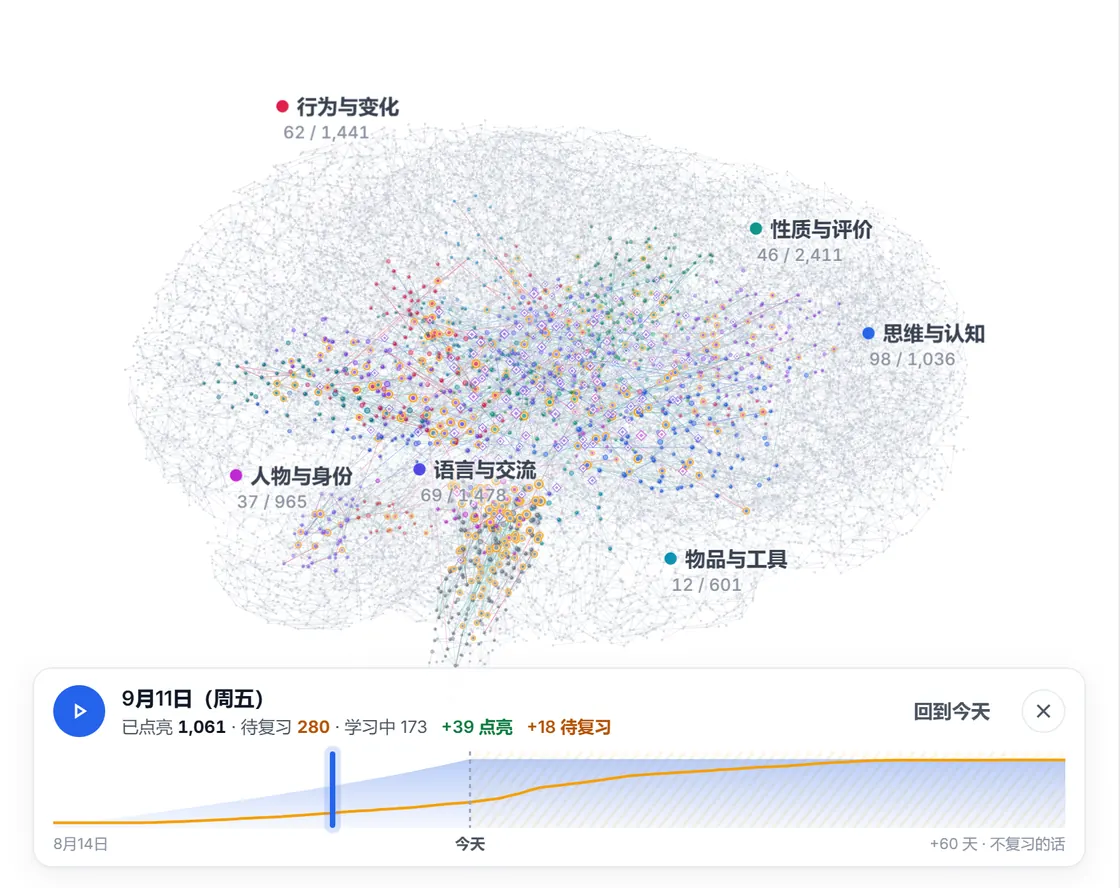
With LexiBrainEvery word has a status: Learning, Lit or Due. Drag the timeline to see how each day changed.
Languages
Each language you learn gets its own brain, with its own words, links and progress. Every brain has the same 25 regions and five shapes, so a meaning lives in the same place in each one.
English · 16,328 words
spectlook
中文 · 6,945 words
日本語 · 8,000 words
電
한국어 · 7,000 words
학 學
Español · 6,000 words
nightnuitNacht
Français · 6,000 words
nightnocheNacht
Deutsch · 6,000 words
nightnochenuit
Coming next
Tap a word to hear it
What LexiBrain does
Questions get harder or easier as you answer, the estimate allows for lucky guesses on multiple choice, and you get a range rather than a made-up number.
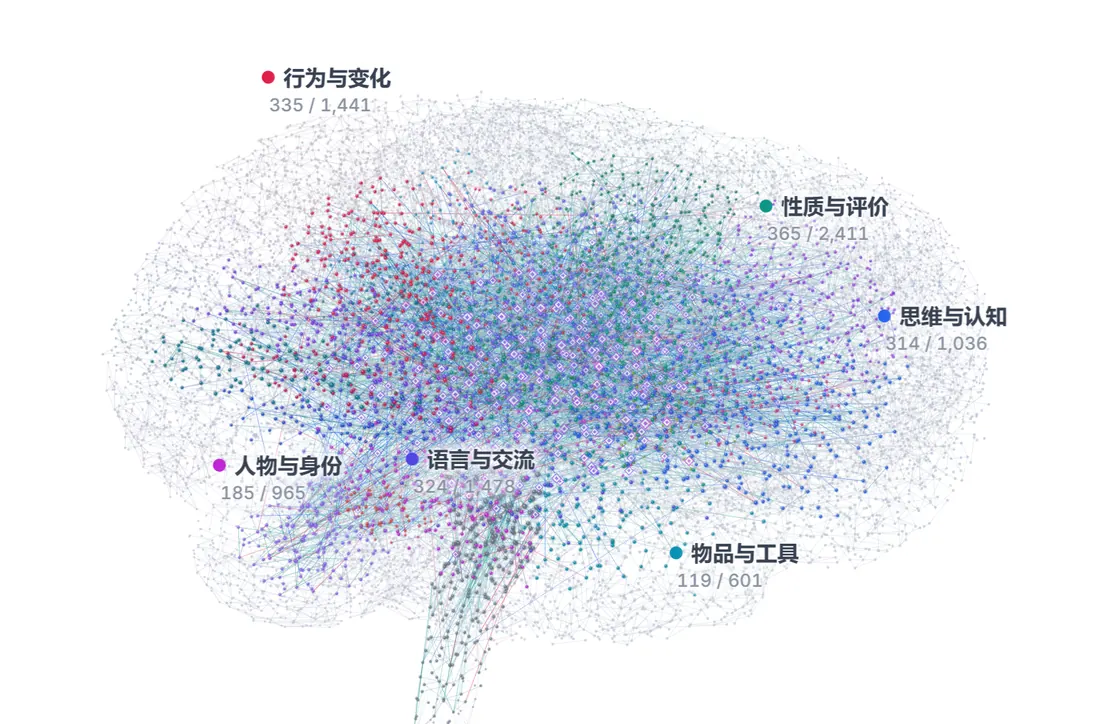
Links are colored by type: word family, synonym, antonym, related word, or a shared root, affix or character. Hover over a line to see how two words are related and how one becomes the other.
Drag the timeline and the brain goes back to how it looked that day: how much was lit and which words were due. Press play to watch from day one to today, with each day's newly lit words flashing.
Lit words get tested in real sentences: one word is blanked out of an example, and you pick the best fit from four.
Besides the daily picks, you can wander the brain freely: open a few words that interest you, a root, or a topic. Afterwards a "Just viewed…" bar appears, so you can take a short quiz on what you picked or simply learn it.
Letting learners choose what to study improves both motivation and results (Patall et al., 2008, a meta-analysis of 41 studies).
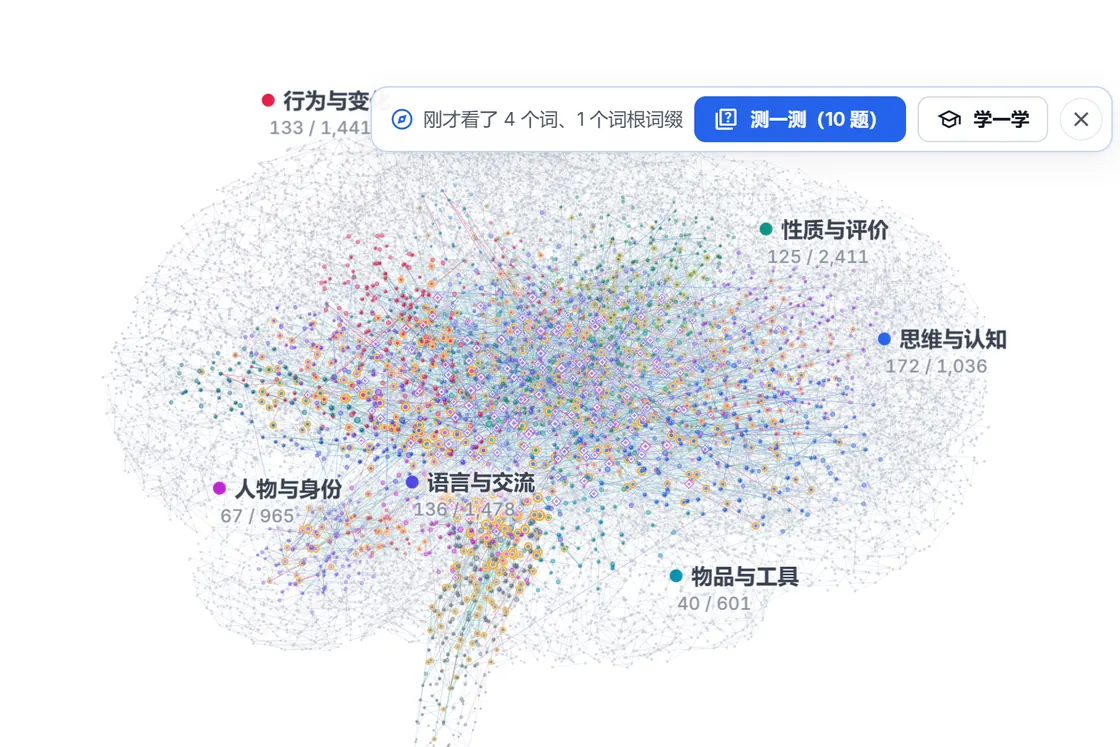
Each new word starts with one question: if you know it, it lights up right away without using up today's quota; if not, you study its card (root, examples, related words). New words start pale and turn solid only when you get them right in the next day's review.
Paste a list or upload a file from a textbook, a class, Anki or Quizlet. LexiBrain matches it against the brain, including plurals, other spellings and accents, and turns the matches into a word list you learn like any other.
Tell LexiBrain why you're learning and how many minutes you have each day, and it suggests where to start and how many new words to take on. Planning a trip, a move or a test? Add the date: reviews come closer together as it nears, and the last few days are for review only.
Origins
Every brain connects to Origins, a 3D family tree of the languages you learn. Follow a word back to its ancestors, see which words were inherited and which were borrowed, and light up the families you recognize.
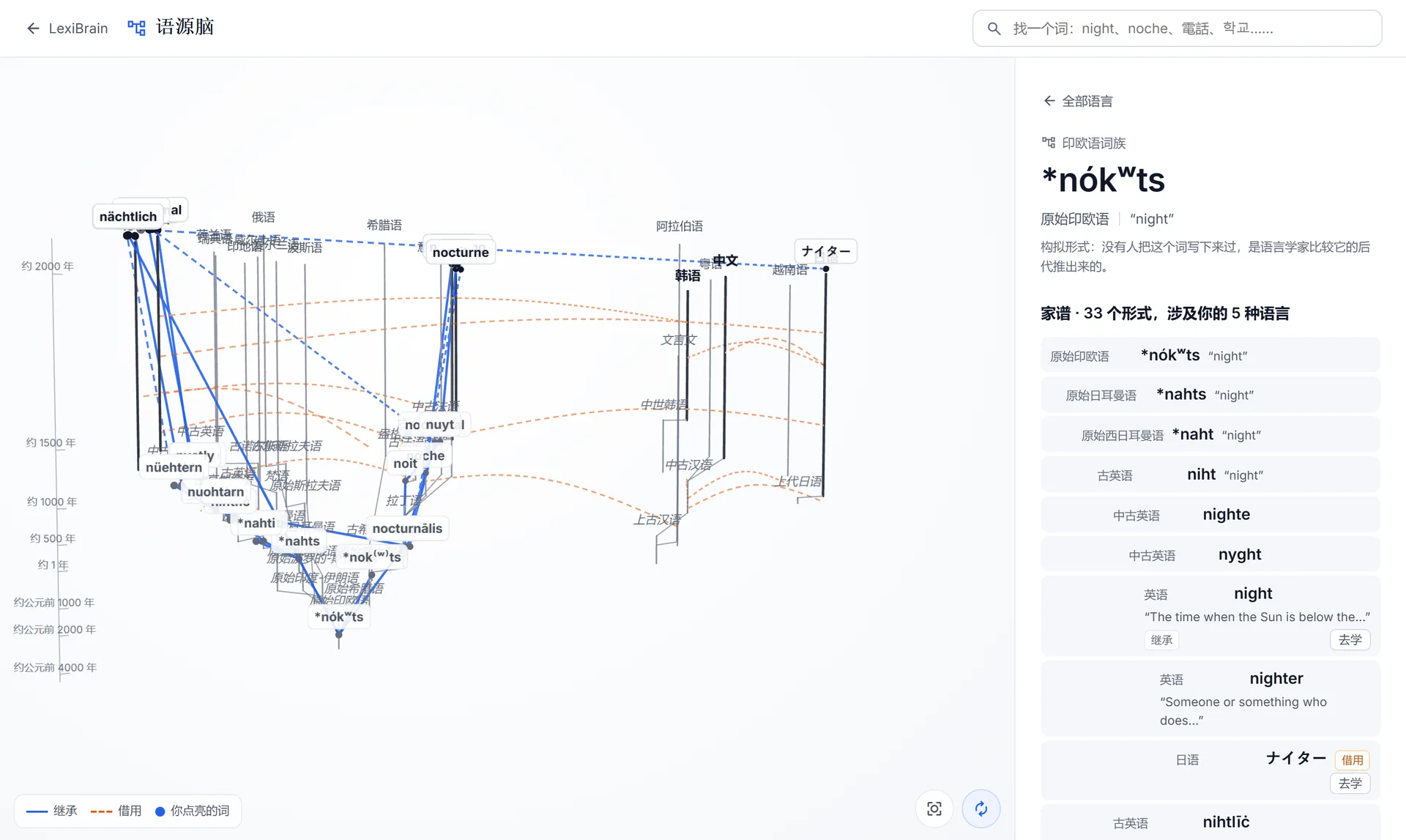
Pick a meaning, like night or water, and see how it's said across up to 235 languages, grouped by family. Indo-European words from the same ancestor share a color and show the reconstructed root.
See how 3,592 Chinese characters sound in Tang-dynasty Chinese, Mandarin, Cantonese, Japanese, Korean and Vietnamese, side by side. Characters that once ended in -p, -t or -k show how the sounds changed.
Data: IE-CoR, NorthEuraLex, Unicode Unihan and Wiktionary
More details
Each word you light up nudges the number higher. Every region has its own progress, and the more you learn, the more solid its color. The few thousand most common words make up most of what you read and hear.
Words are sorted into 25 regions by meaning. Roots and affixes tie word families together, and in Chinese, Japanese and Korean, so do shared characters.
The FSRS spaced-repetition algorithm schedules each word from your study and quiz history: words you know well wait longer, and ones the model predicts you're about to forget come first. Each day, you only do what's due.
47,264 words across the 7 brains come with real example sentences, most of them from Tatoeba.
Gray means not started, pale means learning, solid means lit, and an orange ring means it's due. A lit word never goes dark; it just reminds you to review.
Color the brain by topic, part of speech, frequency or learning status, and English by CEFR level too. Lines can be shown or hidden by type.
Five shapes
Brain, planet, islands, galaxy, word tree: the same words, the same links and the same rules for lighting up. Pick the one you most enjoy looking at, and most want to light up.
Example from the English brain
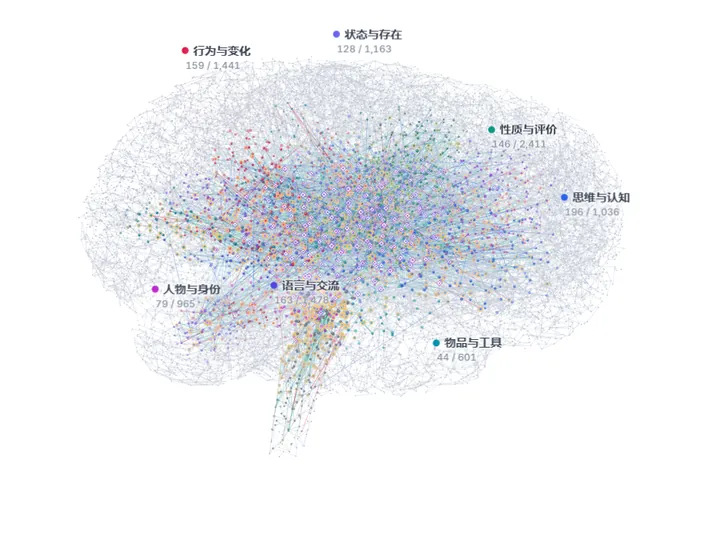 BrainWords live inside a 3D brain, with common words deep in the middle. Peel away the outer layers one at a time to see inside.
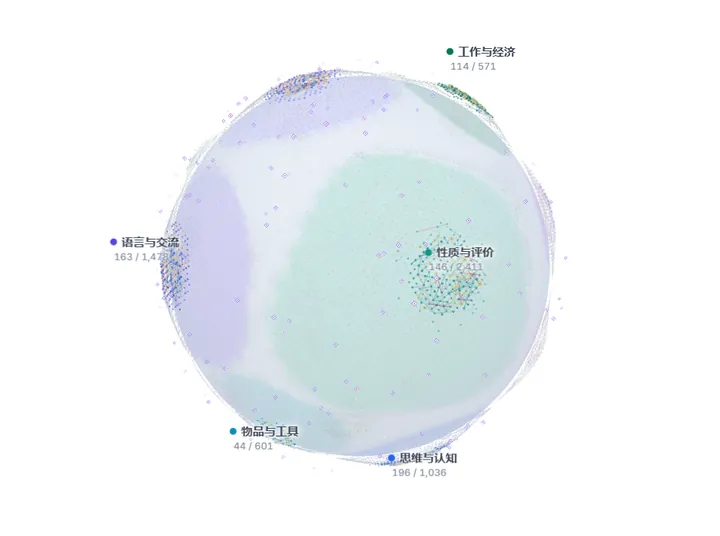 PlanetEach topic is a continent, and the more you learn, the more solid its color.
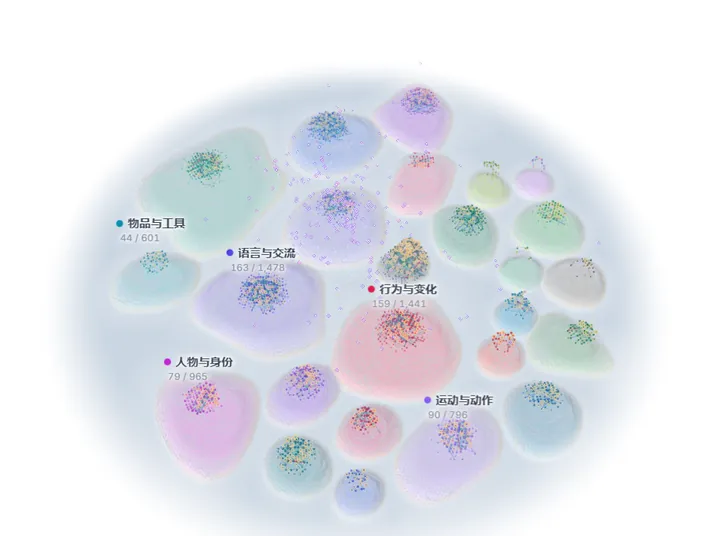 IslandsEach topic is an island, with common words piled up into its peak. It reads like a map and is easiest on a phone.
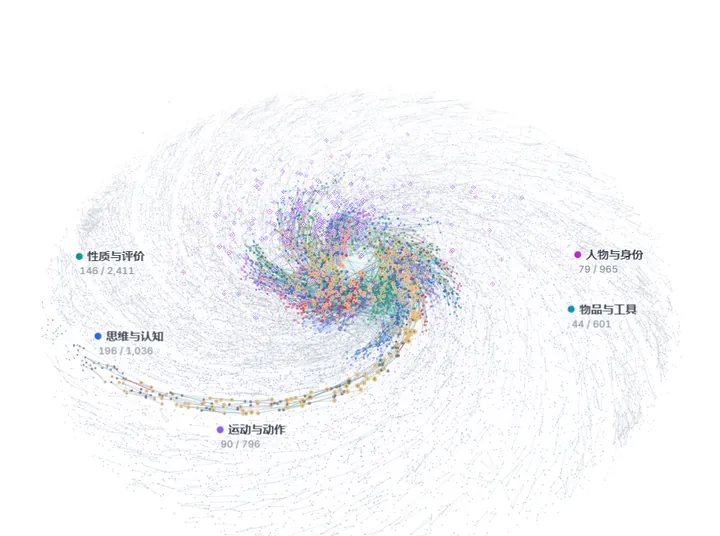 GalaxyCommon words sit at the core and topics spread along the spiral arms, lighting up from the center outward.
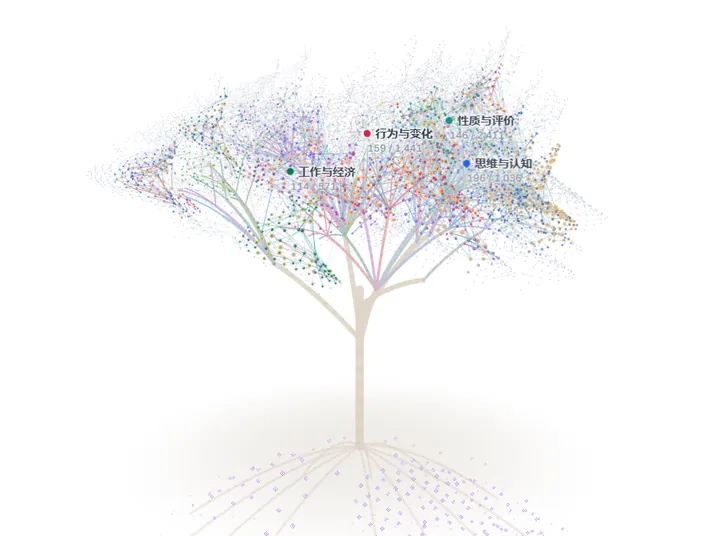 Word treeMain branches are lobes, smaller branches are topics and leaves are words; roots and affixes grow underground.
Learn your way
LexiBrain is made for people who learn because they want to. Tell it why you're learning and how much time you have: it only picks where to start and how many new words a day. Everything else stays open to explore.
How it works
A 4-minute adaptive test. Common words you very likely know light up right away, so your brain isn't empty from the start.
At your own pace. A quick check comes first: words you know light up right away. For the rest, study the card (roots, examples, related words), then take a short quiz.
New words start pale and turn solid when you get them right the next day. Quizzes also include a few spot checks, so what's lit keeps getting more accurate.
More and more words light up and the lines grow denser. Orange rings remind you to review, and the timeline records every day.
The research
LexiBrain's learning flow draws on research about testing yourself, spacing out reviews and more; here are the main findings. They guide the design; whether LexiBrain as a whole helps you learn still needs to be tested with real learners.
Testing yourself beats rereading: a week later, a group that took repeated tests remembered 61%, versus only 40% for a group that reread.
So self-ratings only schedule reviews; words light up through quizzes and the vocabulary test. The test first lights common words you very likely know, and daily spot checks then correct that step by step.
Roediger & Karpicke, 2006 · Psychological ScienceFive minutes after studying, rereading actually comes out ahead (83% vs. 71%). And with foreign-language words, if you stop testing a word once you recall it, you forget many of them within a week.
So new words start pale and turn solid only after you get them right the next day.
Roediger & Karpicke, 2006 · Karpicke & Roediger, 2008 · ScienceWith the same number of reviews, spacing them out beats cramming them together, and the longer you want to remember, the longer the ideal gap.
So FSRS-4.5 schedules each word from its own history. It currently uses standard parameters, not ones fitted to your long-term record.
Cepeda et al., 2006 · Psychological Bulletin (meta-analysis)Trying to answer before seeing the answer helps you remember better than just reading the answer, even if your first try is wrong.
So each new word starts with a quick check; even a wrong answer isn't wasted.
Kornell, Hays & Bjork, 2009 · Richland, Kornell & Kao, 2009Studies found that learning new words within one theme (frog, hop, pond) may help, while learning a batch of similar words of the same kind at once tends to mix them up.
So LexiBrain suggests new words along the links, and a new word's synonyms and antonyms come a few days later. Word families are there to make word building easy to compare; their effect on memory still needs testing.
Tinkham, 1993, 1997 · Waring, 1997Multiple-choice answers can be guessed, so "share correct × number of words" overestimates. LexiBrain picks questions with item response theory and allows for guessing in the estimate. In an internal simulation (English brain, 45 simulated learners), the median error was 17% (vs. 29% for the older banded sampling). That is not accuracy measured on real users, and each of the other brains needs its own checks.
So results come with a 90% range, and only words you very likely know are lit right away.
LexiBrain's internal simulation, not real-user data · Method described in the project docsSeven: English, Chinese, Japanese, Korean, Spanish, French and German, each in its own brain with its own progress. The interface comes in 13 languages, and meanings are shown in the one you choose. Switch between brains anytime; your progress in each one is kept.
It's free, all of it. You can take the 4-minute test without an account; to keep learning, create a free account with your email. It keeps your progress safe and syncs it between your devices, and you can export it to a file anytime. There are no ads and nothing to buy.If you'd like to help with the costs, you can support LexiBrain.
You decide: 5 to 60 minutes a day, which LexiBrain turns into a number of new words (about 12 for 15 minutes), plus any reviews that are due. Have a date in mind, like a trip or a test? Add it, and Today shows how far you'll get by then.
The most common words are a safe start in any language, and the 4-minute test shows roughly where you are. You can also pick a level (CEFR for English, HSK for Chinese, JLPT for Japanese, the official vocabulary levels for Korean), a list for study or work, or your own list.
Yes. Paste a list or upload a text, CSV, Anki or Quizlet file. The words that match the brain (including plurals, other spellings and accents) become a list you learn and review like any other, and you can download the ones that didn't match.
A page for the curious that joins all your brains: a 3D family tree of your languages, where each word links back to its ancestors and relatives. It also compares 949 everyday meanings across up to 235 languages, and shows how 3,592 Chinese characters are read across East Asia.
Most people know common words best, and their knowledge thins out further down the list: an estimate of 8,000 words doesn't mean you know all of the 8,000 most common ones, since part of it is scattered rarer words. LexiBrain only lights up common words from bands where you know at least 90% on average, so that few words light up by mistake. The rest light up gradually through daily spot checks and quick checks. To light up more, pick a bolder option for lighting up after the test in Settings.
Solid means remembered: you got it right in a review the next day, or the first time you saw it (you already knew it). Common words the vocabulary test is confident you know are solid too; later spot checks correct them. Words you just learned or recently got wrong are pale (Learning). They come up in later quizzes and turn solid once you get them right.
No. The same words and links can also be shown as a planet (each topic a continent), islands (each topic an island), a galaxy (common words at the core, topics along the spiral arms) or a word tree (roots and affixes underground). Switch anytime.
They come from open dictionaries and example-sentence collections; where those have gaps, and for translations of the examples, AI drafted the text. We run structural checks and AI spot checks, but native speakers haven't reviewed each language yet, so there may be mistakes. If you spot one, tell us with “Report a problem with this word” at the bottom of the word card.
From open data: dictionaries such as ECDICT, CC-CEDICT, JMdict, the Basic Korean Dictionary and Wiktionary; word frequencies from wordfreq; example sentences from Tatoeba; levels from CEFR-J, Octanove and the HSK and JLPT lists; and for Origins, IE-CoR, NorthEuraLex and Unihan. The Data sources page lists every source and its license.
It's free: take the 4-minute test right away and see how much of your brain is already lit. Then create a free account to keep learning.
Each language gets its own brain and its own progress. You can add more languages later.